By Asherah Boyer
Dance leader and frame drummer, France
A French reflection on the Dances of Universal Peace, accompanied by original non-documentary illustrations.
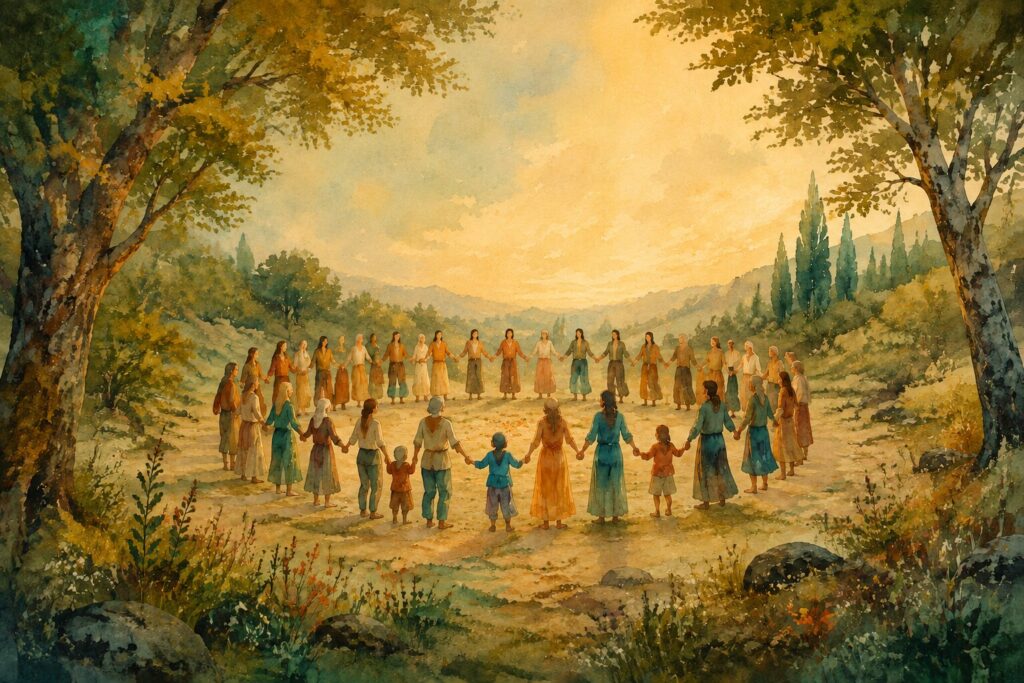
Before temples, before sacred texts, before dogmas and theologies, there was the circle. Human beings standing around a fire, feet planted in the earth, breath mingling with that of others, voices rising together toward something greater than themselves. They turned, stamped the ground, swung their arms, bowed their heads. They did not pray—they were the prayer. Their entire bodies became instruments of communication with the living, with the invisible, with that sacred fabric connecting all things. It is from this memory that the Dances of Universal Peace were born.
A River Flowing from the Very Beginning
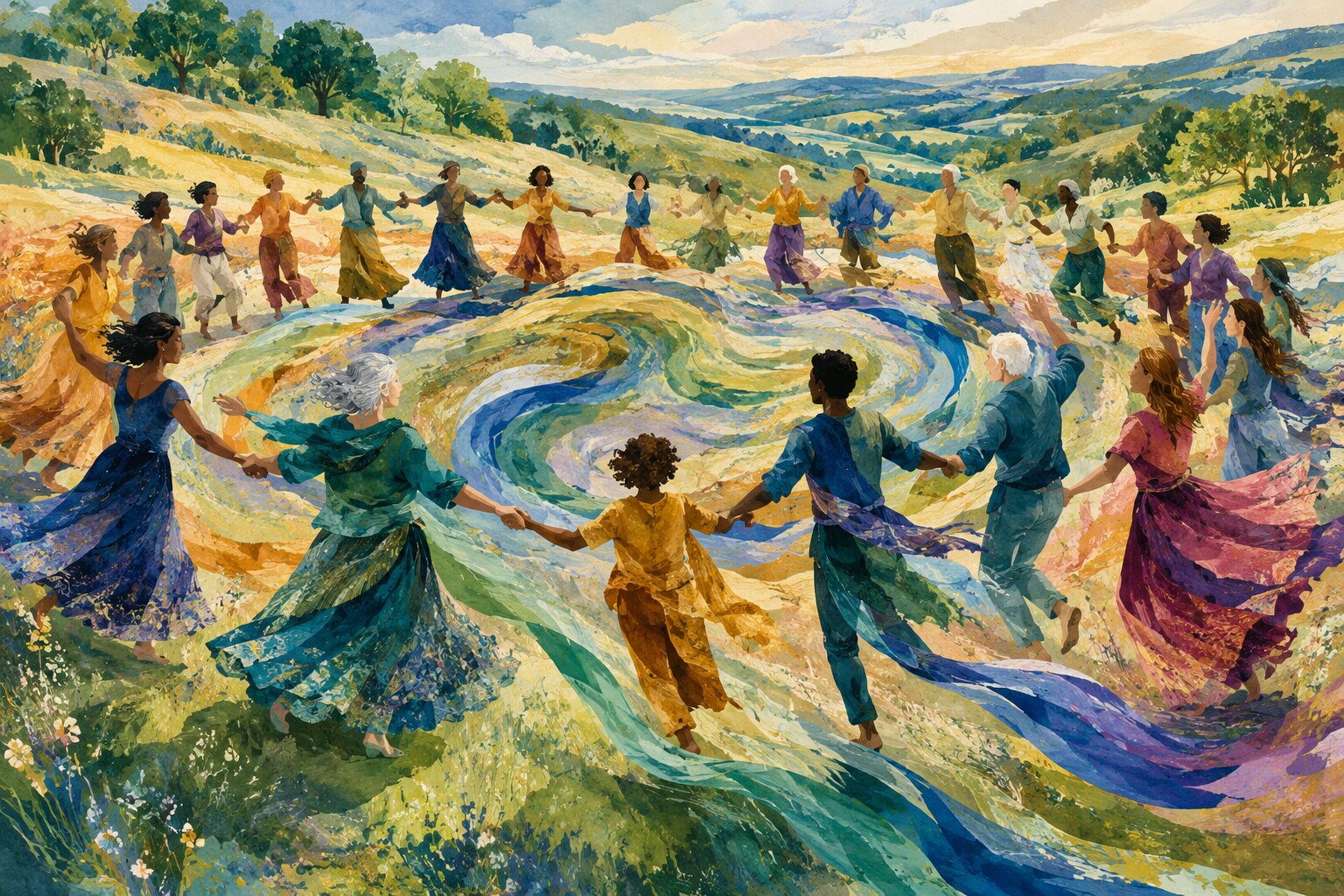
Indigenous peoples never separated body from soul, movement from sacred word, or dance from ritual. Across every continent and latitude, human communities have danced to invoke, to heal, to honor, and to cross thresholds. Dancing to call for rain or give thanks to the earth. Dancing to accompany the dead or welcome the newborn. Dancing so that something greater might enter the circle of the living. These forms vary infinitely depending on the peoples and the lands. Yet they share a profound insight: the body is the meeting place between the human and the sacred. It is the royal gateway to the Divine. The Dances of Universal Peace, created in the 1970s, draw from this universal source. They bring together sacred phrases, melodies, and movements from the great traditions—Islam, Christianity, Judaism, Hinduism, Buddhism, Native American traditions, and others—allowing them to come alive together, within a single circle, through bodies in motion. This is not superficial syncretism. It is the recognition that something essential runs through all these forms—and that the body knows how to recognize it, even when the mind hesitates.
The Sacred Phrase Embodied
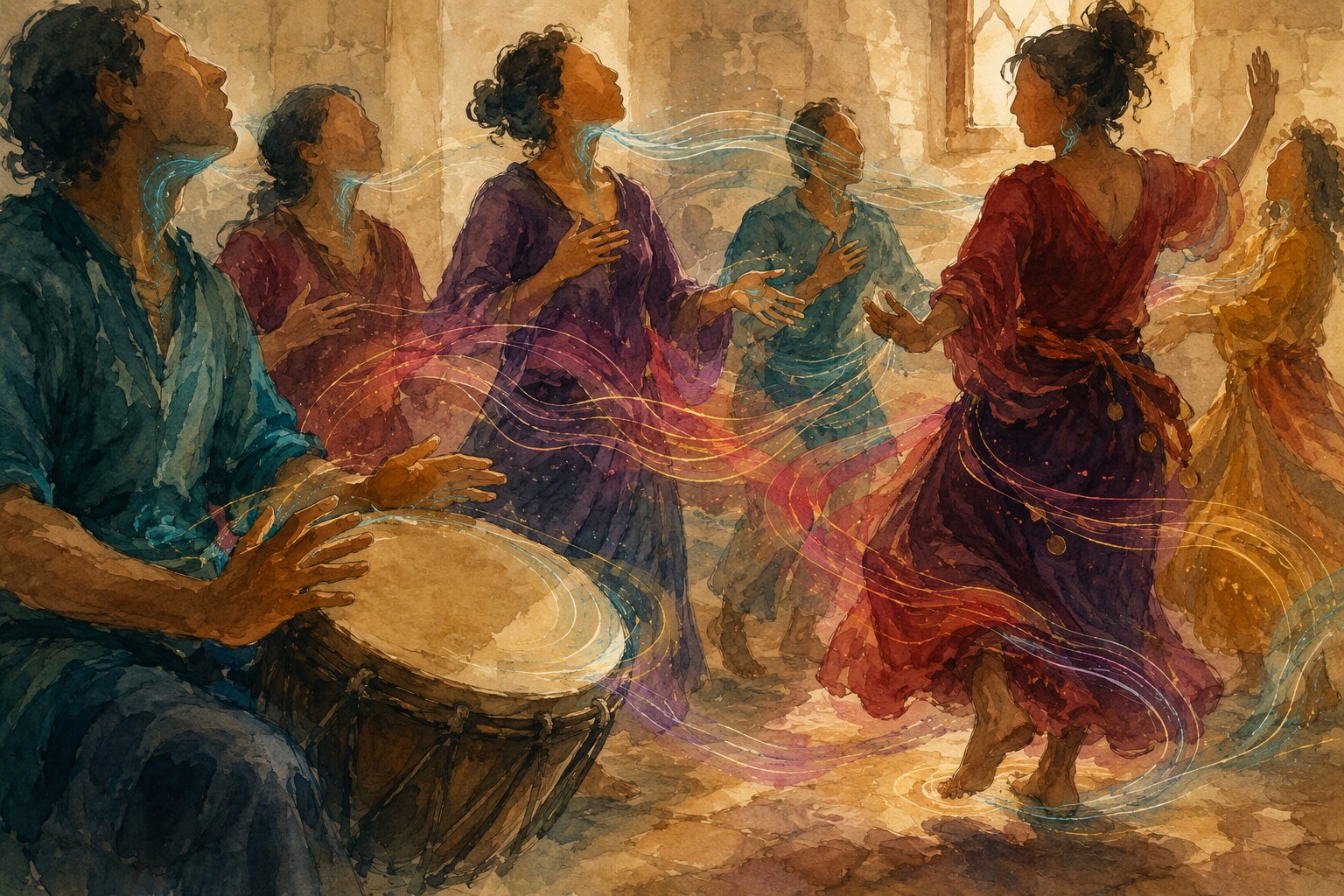
At the heart of the Dances of Universal Peace lies a unique alchemy: the marriage of song, gesture, and movement. One does not merely recite a sacred phrase—one becomes it. Embracing the syllable Om, feeling its resonance descend into the belly. Letting Ya Hayy, Ya Haqq—“O Living One, O Truth”—flow through the throat and imprint itself upon the shoulder blades, the wrists, and the very way the foot meets the ground. Singing Shalom, Salaam, Peace while looking into the eyes of the person opposite, and sensing that these three words are the same breath that has flowed through all beings for millennia. This is where the mind recedes, making way for the body as a temple of the Divine. The body cannot pretend to feel. When a sacred phrase is sung and embodied in a precise, repeated movement within a group, it descends. It carves a groove into the flesh, into cellular memory. Devotional movement and song become a form of writing upon this living tissue; they encode something that the body retains long afterward—far beyond what the rational mind holds onto.
When Transformation Is Real
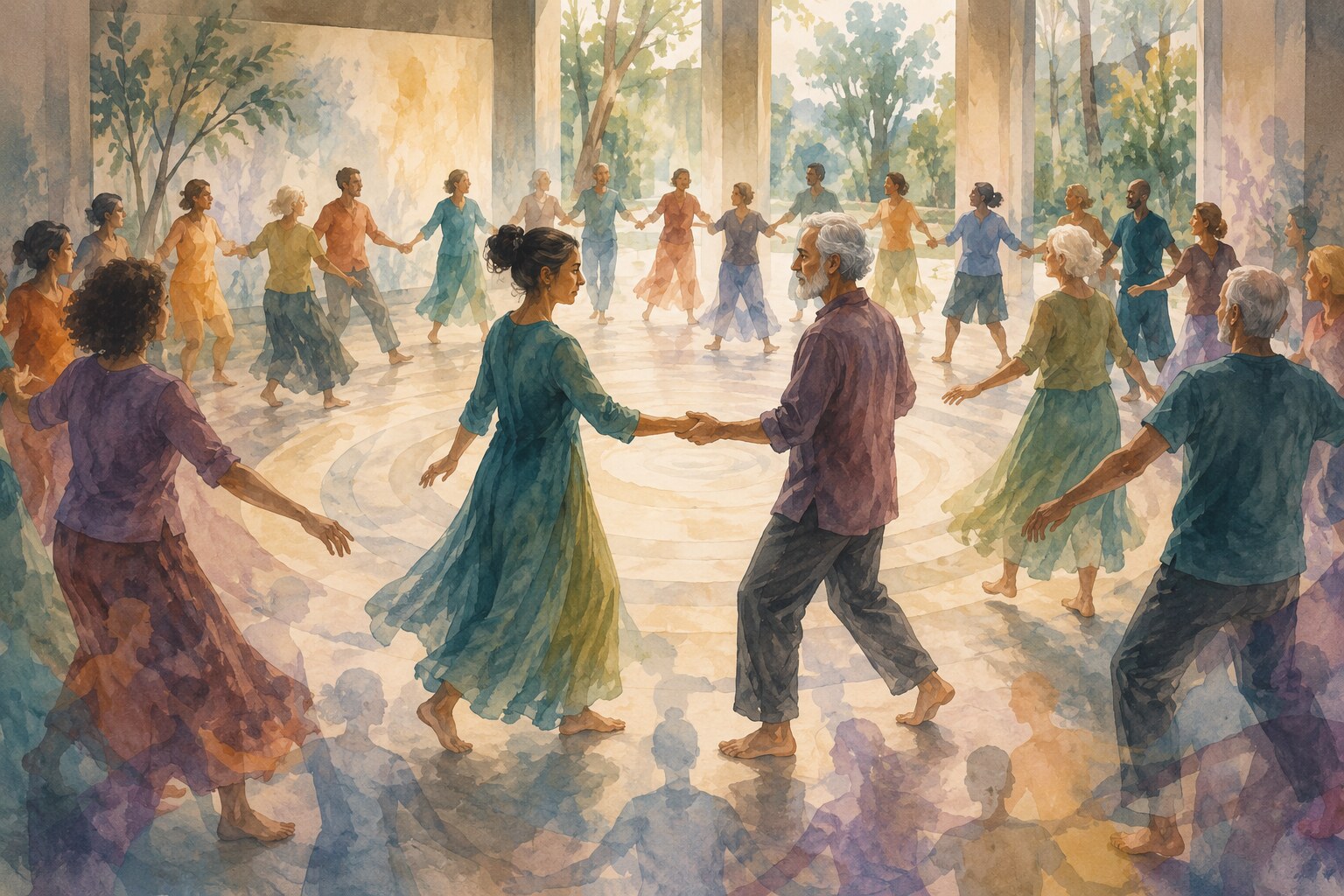
The Dances of Universal Peace are not merely beautiful. They do real work, operating simultaneously on multiple levels—levels that contemporary somatic approaches are beginning to illuminate. Singing in a circle—repeatedly, carried by the collective—soothes the nervous system. Something within us recognizes this form—the group, the rhythm, the gentle predictability—and settles down. We step out of survival mode. We enter into presence. Coordinating steps, gestures, voice, and our connection to others all at once demands a total, living awareness of the body. For those who have learned to withdraw from themselves, this in itself is a form of healing. The repetition of the same dances, across various gatherings and seasons, imprints something profound. The body recognizes before the mind understands. And this recognition is therapeutic—it simply says: you are here, you have been here before, you can return. And then there is what I call the opening—when, as we turn through the space and meet one another’s gaze, the tension of the isolated self begins to gently unravel. It is not a dissolution, nor a loss of self, but a living experience of our lack of separation.
What the Circle Holds
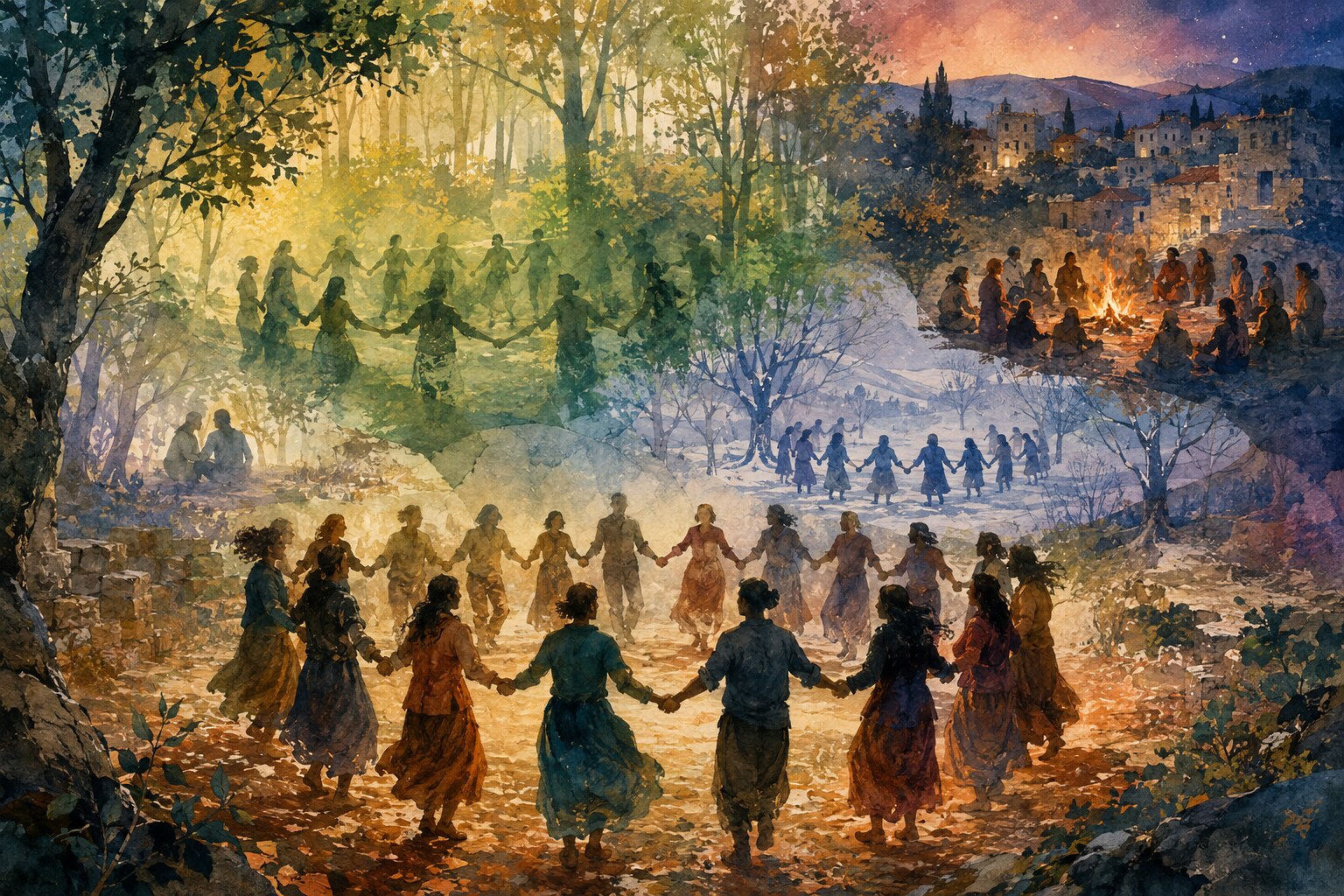
In the Dances of Universal Peace, something greater than the sum of the individuals present is invoked. Within this circle lies the memory of all human circles—those formed around the fire, in the forests, or in village squares. It is the memory of a time when ritual dance was the natural way to move together through the seasons, through grief and joy, and through life’s transitions. This memory is not a metaphor. Each dancer recognizes it in their very flesh, often without being able to explain it—that feeling of having done this before, of being in the right place, of rediscovering something fundamental. Peoples who have kept their embodied rituals alive know this: we do not heal alone, nor do we transform without engaging the body and the community. Ritual is what connects us—to ourselves, to others, and to that which transcends us. The Dances of Universal Peace offer us this return. They belong to no single, exclusive tradition; rather, they respectfully draw nourishment from them all. And they remind our Western bodies—so often disconnected and deprived of collective ritual—that we, too, are beings of the circle. That we can rise, turn toward one another, sing, and move together—and that in doing so, something falls back into alignment.
What the Body Knows
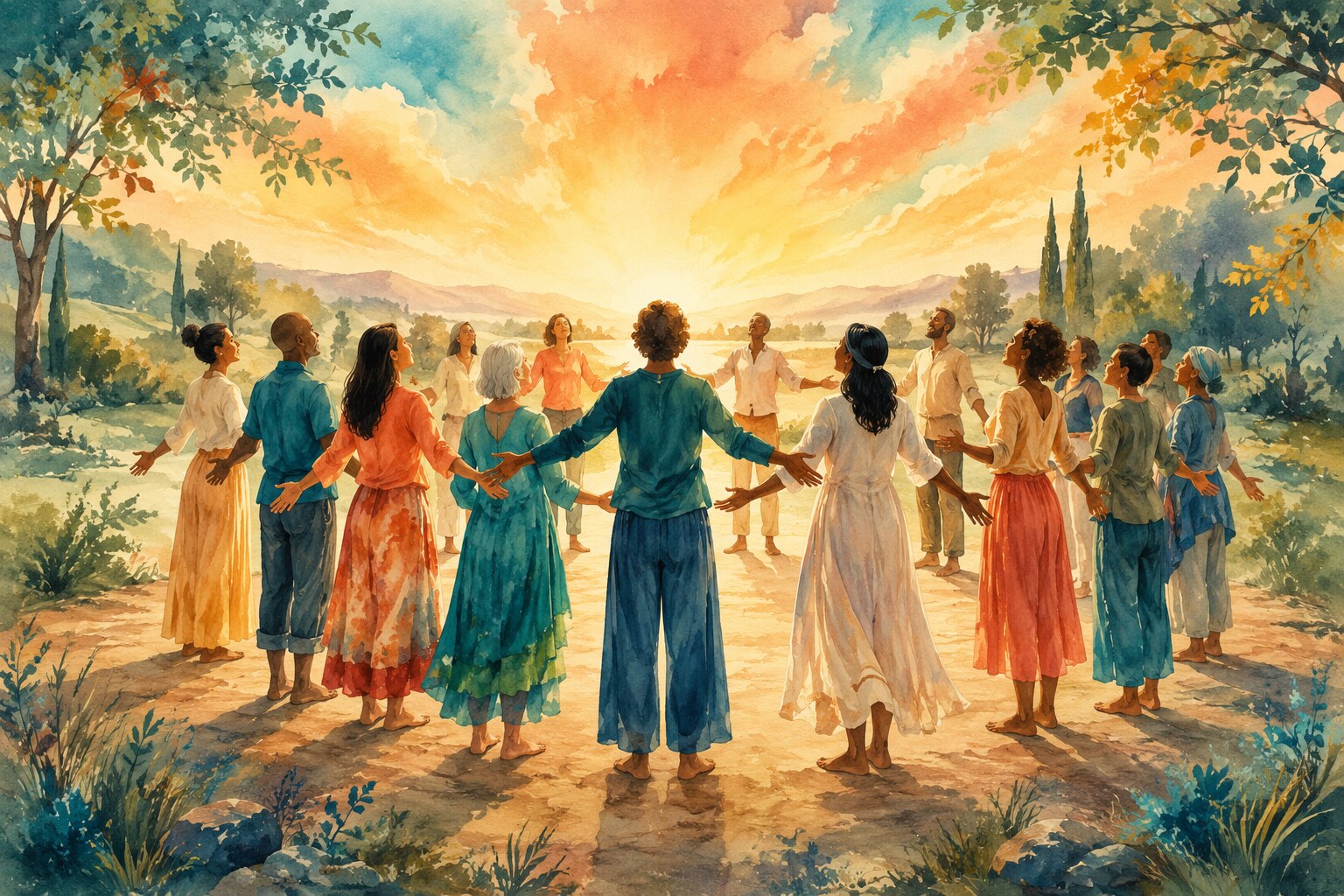
One does not leave a Dance of Universal Peace the same way one entered. It is not a spectacular transformation but something gentle and profound: a lightening of the spirit, a softness in the chest, a sense of having been held by something greater than oneself. The heart opens wider. In the legs, there is that rare sensation of being both grounded and light. Then we begin to understand—not with the head, but with the whole body—that the sacred does not lie beyond matter but flows through it. That a phrase of peace whispered in Hebrew, Arabic, or Sanskrit is not an abstract idea but a tangible act of care for the living fabric of this world. That moving in a circle with other human beings—meeting their gaze, blending our voices with theirs—is one of the most ancient and essential acts we can perform. A return to the body as a temple. To the circle as the fundamental form of human community. To a prayer that excludes no one, because it arises from what all humans share: feet upon the earth, arms capable of embracing, and a voice that can sing of peace.
About Asherah Boyer
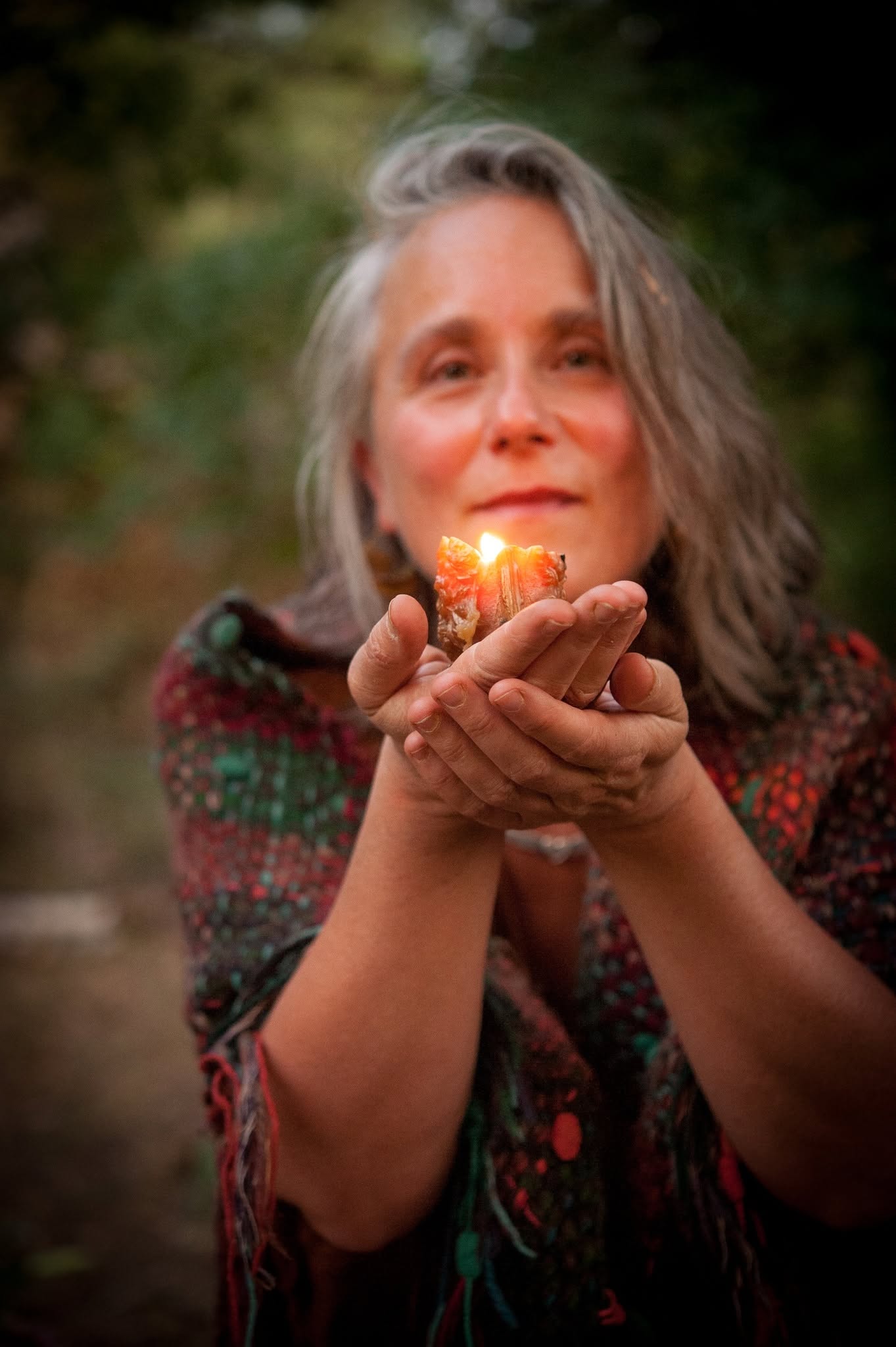
Asherah Boyer is a Dance Leader, frame drummer, and Sufi initiate from France. She is also a Mentor in Training and an initiator in Sufi Ruhaniat International. She has been leading Dances of Universal Peace for the past thirteen years.
She is passionate about the Aramaic teachings of Yeshua and the Goddess tradition. With her husband, Umun, she is the keeper of an old forest in Aveyron, where they lead annual retreats combining the depth of the Aramaic teachings with life in the forest, drawing on the power of Nature to open seekers’ souls and hearts.
She is a psychologist, kinesiologist, and flower-essence practitioner.
Facebook: Asherah Boyer
AI-generated images prompted by Patrick Harrigan.